



My name is Lilah Jacobs, and I am a senior at the University of Tulsa (TU), triple-majoring in political science, economics, and Spanish. This isn’t as much work as it sounds. In high school, I did the International Baccalaureate (IB) Program and started college as a sophomore. IB is basically Advanced Placement (AP) but is used and recognized around the world. It was originally developed as a standard curriculum for the frequently moving children of diplomats. When I tell people from outside Tulsa that I did IB, they instantly assume I went to a predominantly White and wealthy private school. I actually went to Booker T. Washington (BTW), a historically Black Title I high school. How did a historically Black high school in a marginalized part of Tulsa become one of two IB schools in Oklahoma? Desegregation.
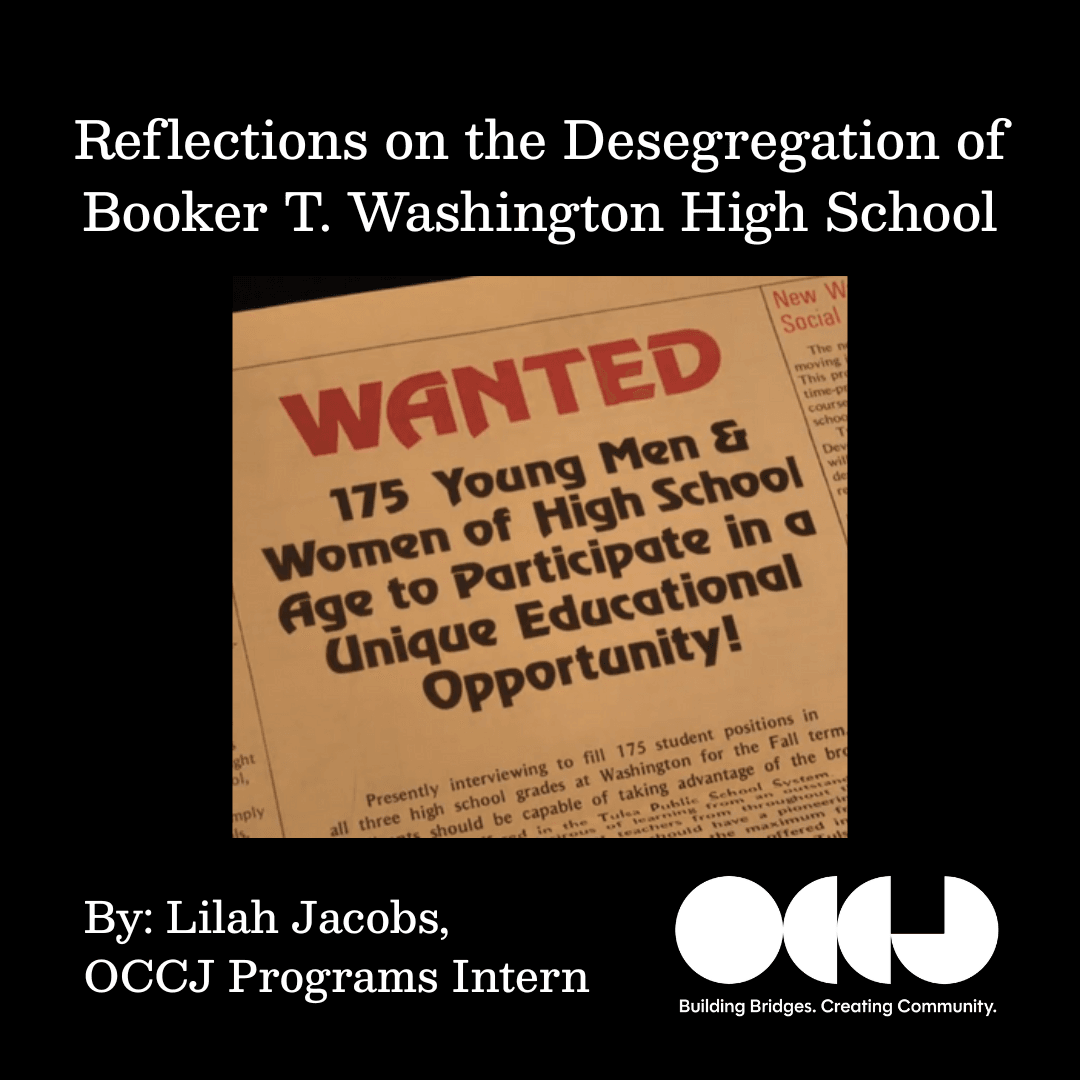
While Brown v. Board (1954) officially outlawed racial segregation, there was a lot of racist resistance to the decision. Actual integration took much longer and was realized through the hard work of dedicated activists and community members. In fact, OCCJ (then known as Tulsa NCCJ) was one of these changemakers. Through hosting dialogues, lifting voices of color in media, and organizing, OCCJ helped Booker T. Washington become the first voluntarily integrated school in the United States in 1970, and later Tulsa Public Schools’ vehicle for the desegregation program. During integration, BTW was given many resources from academics to sports to encourage White students to attend high school in predominantly Black North Tulsa. And that is why today BTW can offer its students opportunities like IB.
As we get back into the school year, I think of all the blood, sweat, and tears that went into ensuring students of all colors could learn together—just one of many victories of the larger Civil Rights Movement of the 1950s and 60s. The Civil Rights Movement fought against a system of racial segregation that kept Black people and people of color separate for the purpose of marginalization. Looking back at this period of American history, I am not only inspired by the movement’s higher ideals of justice and equality, but also the daily grit and determination of its leaders and participants. This movement lasted over 10 years, a huge length of time, especially in comparison to today’s world of 24-hour news cycles and one-minute videos. Creating real and meaningful change takes years of hard work and dedication.
This is why it is vital to invest in tomorrow’s leaders—something OCCJ does through its youth leadership programs. By facilitating cross-cultural dialogues and equipping youth with leadership skills like problem-solving, emotional intelligence, and critical thinking, OCCJ empowers future generations to lead change. At this moment in time, when efforts to advance civil rights and equality are being attacked, we must draw inspiration from the past to find perseverance today. Progress is all around us, and while hard, it is possible.
